Connect distributed systems. Keep trust in your hands.
CrosLink is a managed mesh overlay network built on QNyx, Xaoc Industries’ purpose-built secure transport protocol. It brings node identity, encrypted connectivity, and network operations into one coherent architecture.
Post-quantum cryptography inspired by CNSA 2.0. A control plane designed to coordinate—not terminate—your protected data paths.
CrosLink is under active development. Cryptographic design references are not a claim of CNSA certification or product validation.
OVERLAY TOPOLOGYQNYX TRANSPORT
Encrypted peer linksControl coordination
01Identity-first
Nodes are enrolled and authenticated through cryptographic identity.
02Separated planes
Management coordinates the mesh; protected traffic follows its data path.
03Protected transport
QNyx provides authenticated, encrypted transport with post-quantum design.
04Operator visibility
QCore presents network state, changes, and operational feedback.
ARCHITECTURE
Three cooperating components. Distinct trust responsibilities.
CrosLink is not a single tunnel endpoint with a dashboard attached. It is a system in which the transport, coordination service, and operator interface each have a defined role.
01 / DATA PLANE↔
QNyx
Secure transport at the node
QNyx runs at the network edge. It establishes authenticated peer sessions, protects traffic in transit, and connects the overlay to the host’s network stack.
Purpose-built Rust protocol
Post-quantum key establishment and identity
Authenticated encryption for tunneled traffic
Session lifecycle and rekey management
02 / COORDINATION⇄
QCtrl
Message relay and coordination
QCtrl provides a rendezvous channel between the operator’s controller and deployed nodes. It relays protected management messages without serving as the network’s traffic gateway.
Relays encrypted management payloads
Supports node/controller coordination
Designed to minimize exposed management content
Not an inline data-plane proxy
03 / OPERATIONS⌘
QCore
Fleet controller and operator UI
QCore gives network administrators a place to define desired connectivity, issue authenticated changes, and review status and events across the deployment.
Network and node configuration
Authenticated configuration delivery
Fleet state and topology visibility
Operational actions and diagnostics
Trust boundary: the coordination service is not intended to hold the keys to protected application traffic. QNyx endpoints enforce their own cryptographic session and configuration trust.
NODE LIFECYCLE
From enrollment to an active peer.
The lifecycle is designed to make node trust explicit and operational changes auditable—without asking every administrator to manage cryptographic primitives by hand.
01
Establish node identity
A node creates or loads its cryptographic identity locally. The public identity is used to recognize the participant; private key material remains under endpoint control.
Identity · Local key custody
02
Rendezvous with the controller
The node and QCore find one another through QCtrl. The relay provides a coordination path, while the parties establish a protected management relationship.
Coordination · Protected channel
03
Authenticate and accept configuration
Configuration updates are authenticated against trusted controller identity and checked before they are accepted. A node does not treat arbitrary relay content as an instruction.
Trust validation · Policy enforcement
04
Apply network intent
The node reconciles the accepted configuration with its local tunnel and routing state. Changes are applied at the endpoint, where the network interfaces and peer sessions live.
Desired state · Local execution
05
Operate, report, and recover
Nodes provide health and status information to the controller. Session refresh, reconnection, and lifecycle handling support ongoing operation as conditions change.
Telemetry · Session continuity
DATA PLANE / CONCEPTUAL FLOW
Where packets go—and where trust is enforced.
The protected data path is endpoint-to-endpoint. QCtrl helps coordinate the network, but it is not positioned between the communicating systems as a traffic inspection or decryption service.
Cryptographically protected across the untrusted network Management coordination path
A
Ingress
Traffic selected for the overlay enters the node’s protected networking path. Network intent determines which destinations are carried by the mesh.
B
Protection in transit
QNyx applies peer-session protection before traffic crosses the underlying network. The transport is designed to avoid exposing application content in transit.
C
Peer processing
The receiving QNyx endpoint validates and opens protected traffic, then passes accepted packets back into the destination network stack.
This is a conceptual architecture illustration, not a packet-format specification. It intentionally omits protocol framing, key schedule details, internal concurrency, and implementation-specific behavior.
CRYPTOGRAPHIC DESIGN
Designed for a post-quantum transition.
QNyx uses a cryptographic architecture inspired by the CNSA 2.0 algorithm direction. The intent is to combine modern key establishment, strong identity, and authenticated data protection into a protocol built for secure networking.
KEY ESTABLISHMENT
ML-KEM-1024
Post-quantum key establishment for creating shared session material between authenticated participants.
IDENTITY & SIGNATURES
ML-DSA-87
Post-quantum digital signatures used to support cryptographic identity and authenticated management.
DATA PROTECTION
AES-256-GCM
Authenticated encryption designed to protect the confidentiality and integrity of tunneled traffic.
HASHING
SHA-512
Cryptographic hashing used as part of the protocol’s security design.
⌁
Cryptography is one part of the system.
Secure deployment also depends on identity custody, trusted configuration, endpoint security, operational policy, and correct integration. CrosLink is designed to make those responsibilities visible rather than hiding them behind a single “connect” button.
“CNSA 2.0-inspired” describes algorithm selection and design direction. It does not imply NSA approval, CNSA certification, FIPS validation, or a third-party security assessment.
OPERATIONS FOR TECHNICAL TEAMS
Control the fleet. Keep the data path distributed.
Configuration as intent
Administrators define connectivity and policy at the controller. Nodes validate and apply their own assigned configuration rather than depending on a central gateway to forward every packet.
Node-level enforcement
Cryptographic identity and configuration trust are checked by the endpoint. The coordination service is not treated as an authority simply because it can relay a message.
Fleet state and diagnostics
QCore surfaces device health, peer state, live traffic rates, activity, and configuration outcomes so operators can see what the network is doing—and where attention is needed.
Recovery-oriented lifecycle
Connection management, session refresh, restart, and reconnect actions are available as part of the node lifecycle, helping operators respond to transient conditions.
QCORE / OPERATOR EXPERIENCE
A live network, not a pile of config files.
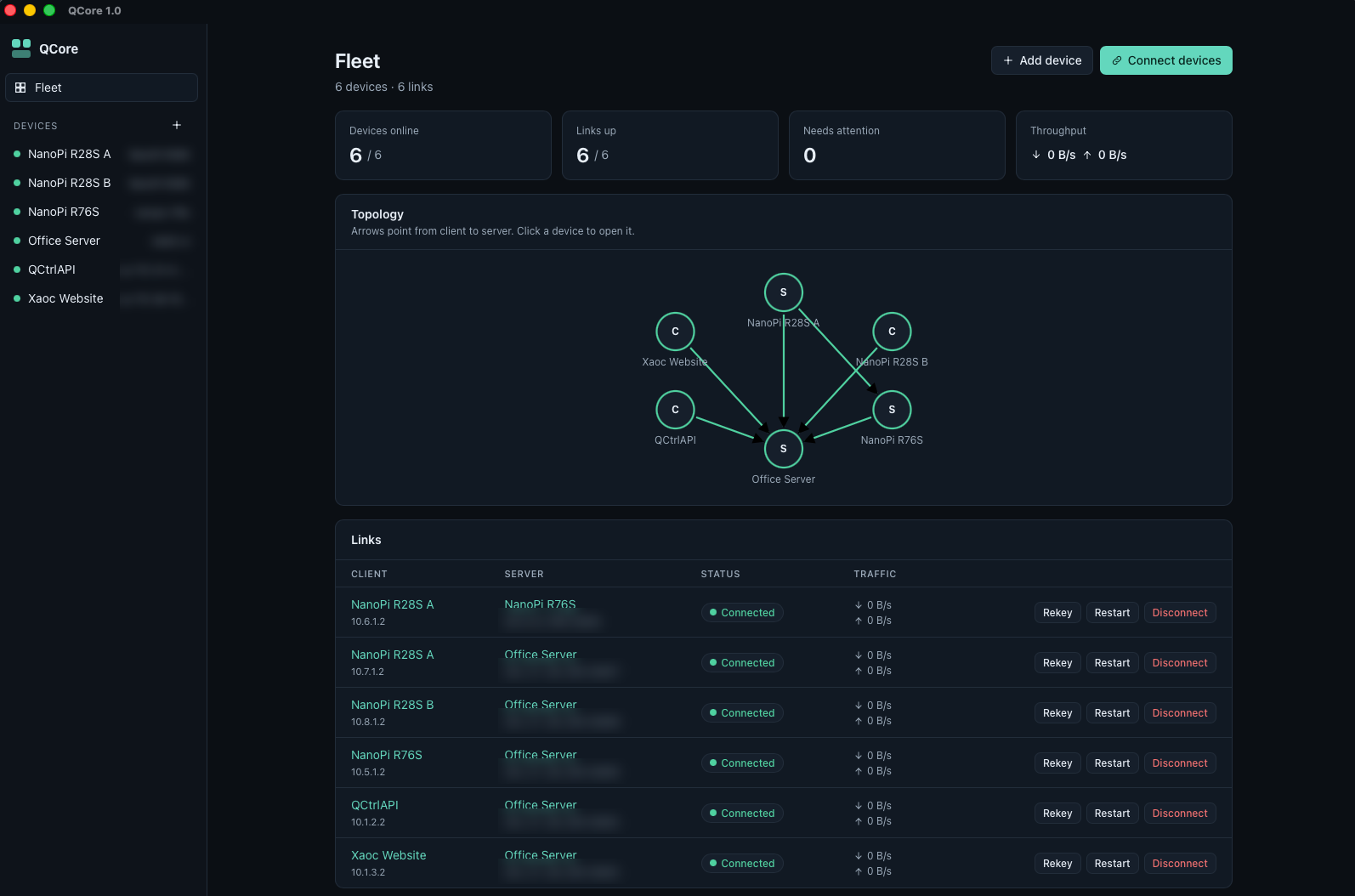
QCore turns the mesh into an operational view: see which devices are online, how peers connect, which links are up, and which nodes need attention. Select a device to inspect its overview, configuration, and daemon logs.
Topology at a glanceVisual client-to-server relationships make the shape of the deployment easier to understand.
Link-level controlsReview connection state and traffic rates, then rekey, restart, or disconnect a link.
Guided device linkingConnect devices through a workflow that handles server/client roles and network options.
Configuration with an escape hatchUse the managed workflow for everyday changes, or inspect and apply advanced JSON directly.
Operational feedbackActivity feed, health indicators, daemon logs, and acknowledgements make applied changes visible.
QCore fleet dashboard — device health, mesh topology, link status, traffic, and operator actions in one view. Development interface.
TRANSPORT FOUNDATION
Performance is part of the architecture.
CrosLink is built on QNyx, a userspace secure transport engineered in Rust. The protocol is designed to deliver practical throughput without requiring a custom kernel module.
In a 10 Gbps test environment, QNyx recorded 5.16 Gbps receiver throughput in a 10-second iperf3 run. The supplied same-environment WireGuard-go userspace result was 3.93 Gbps.
Reported results from a specific test setup; not a universal throughput guarantee. Benchmark methodology and host/network conditions matter.
CTO QUESTIONS
Architecture, without the black box.
A few direct answers for teams evaluating a new secure overlay.
Is CrosLink a VPN or a mesh network?
CrosLink is a managed mesh overlay network. QNyx supplies the secure transport underneath; CrosLink brings together node management, coordination, and overlay connectivity. The exact deployment topology depends on the network design.
Does QCtrl carry application traffic?
No. QCtrl is a coordination relay for protected management exchanges. CrosLink’s protected application data path is handled by QNyx nodes and their peer sessions.
Can the relay read node configuration?
The architecture is designed so management payloads are protected between the controller and node. QCtrl facilitates delivery but is not intended to be the authority that interprets or applies configuration.
What does “CNSA 2.0-inspired” mean?
It refers to the post-quantum algorithm direction informing QNyx’s cryptographic suite. It is not a claim of CNSA compliance, government endorsement, or certification.
Is CrosLink generally available?
CrosLink is under active development. Xaoc Industries is engaging with technically qualified organizations interested in architecture discussions, pilots, and early evaluation.
What information is intentionally not published?
This overview describes the system’s lifecycle, trust boundaries, and cryptographic roles. It does not publish source code, wire-format details, internal key derivation, low-level packet handling, or implementation-specific operational mechanics.
EARLY TECHNICAL CONVERSATIONS
Bring us your network architecture.
If you are evaluating secure connectivity for distributed infrastructure, edge environments, or systems that need a different trust model, we would welcome a technical discussion.